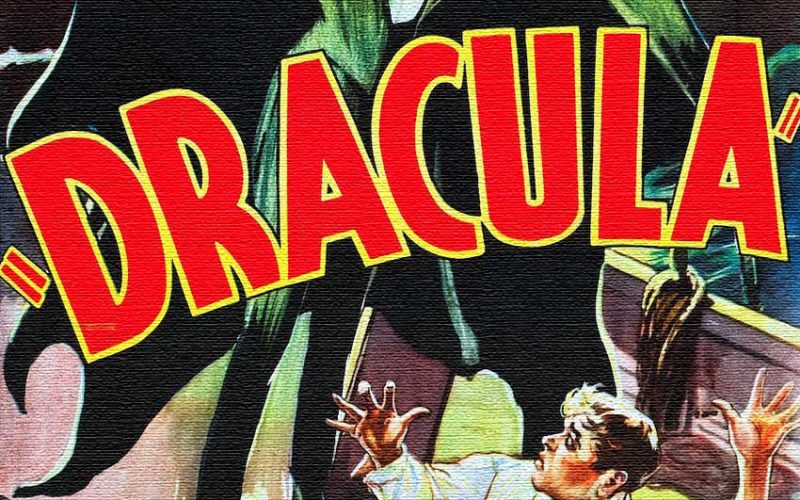
Recently I attended the opening of a gourmet confectionary called R&R Chocolate Palace. As I reached for a Wild Harvested Bolivian truffle, a botoxed woman asked, “Are you in The Industry too?”
The amazing chocolatier, you see, has a day job. He’s the conductor of the Atlantic Symphony Orchestra and the music director behind the soundtracks of several Hollywood blockbusters.
In Los Angeles, you can’t walk into a Starbucks without someone asking you, somewhat desperately, “Are you in The Industry?” Meaning, of course, the entertainment industry, which permeates the city like a layer of smog.
Or fog, if you lived in 19th century London like Bram Stoker (1847-1912).
Stoker knew The Industry well. For over twenty years, he was the personal assistant (PA) to Henry Irving, a leading actor of his time and the first to be knighted.
A Brilliant Public Servant
Before Stoker met Irving, he knocked around Dublin, attending graduate school, writing theatrical reviews, publishing a few short stories, and working as a civil servant. At age 29, he wrote his magnum opus, The Duties of Clerks of Petty Sessions in Ireland, which became a classic in the field.
The same year, however, Stoker penned a flattering review of Henry Irving’s performance of Hamlet.
Until He Met Dracula
In gratitude, Irving invited Stoker to his hotel room for dinner and a private performance. He recited a poem, The Dream of Eugene Aram, about a schoolteacher who batters an old man to death for a bit of gold. The performance mesmerized Stoker:
So great was the magnetism of his genius, so profound was the sense of his dominancy that I sat spellbound. Outwardly I was as of stone…The whole thing was new, re-created by a force of passion which was like a new power.
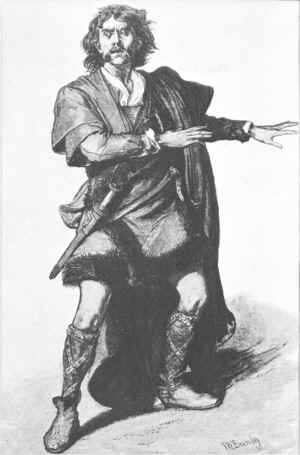
Irving and Stoker became close friends, or perhaps, master and acolyte. According to biographer Barbara Belford, the hypnotic, self-centered Irving is the man who was Dracula.
In 1878, Irving acquired the Lyceum Theatre in London. He asked Stoker to become his PA and theatre manager, a position Stoker held for 21 years, until Irving sold his interest behind Stoker’s back.
What could have caused such a rift?
The Chilling Masterpiece
Two years earlier, at age 50, Stoker had published Dracula. He’d written a few minor novels in his 40s, but none of them rivaled this one. As Barbara Belford tells us,
The novel’s genesis was a process, which involved Stoker’s education and interests, his fears and fantasies, as well as those of his Victorian colleagues. He dumped the signposts of his life into a supernatural cauldron and called it Dracula.
When Stoker asked his employer of almost 20 years what he thought of Dracula, Irving replied, “Dreadful!” He refused to star in a theatrical adaptation.
Belford thinks that Irving felt it beneath his dignity to act in a play written by an employee.
Stoker and Irving’s relationship, however, appears more complicated than that. Did Irving just see an unflattering portrait of himself in the novel? Or was it something else? Certain members of The Irving Society believe that Stoker might have been privy to a very dark secret about Irving. (See “The Ripper and The Lyceum” in First Knight, their Society journal.)
After Irving sold the Lyceum, Stoker stayed on as his personal assistant for a few more years, but the two eventually drifted apart.
Henry Irving died in 1905, never realizing he’d turned down the biggest role of the 20th century.
Finally free, Bram Stoker wrote prolifically until he died in 1912 at age 65. He produced several more novels and a biography of Henry Irving. Stoker’s widow Florence published a short story collection, Dracula’s Guest and Other Weird Stories, after his death.
In 2003, after spending ten months as a PA to a narcissistic magazine editor, Lauren Weisberger wrote The Devil Wears Prada. It too was a sensation, but we’ve already forgotten about it.
Perhaps it takes twenty years under the thumb of a soul-sucking boss and fifty-years acquiring wisdom to produce something with the staying power of Dracula.
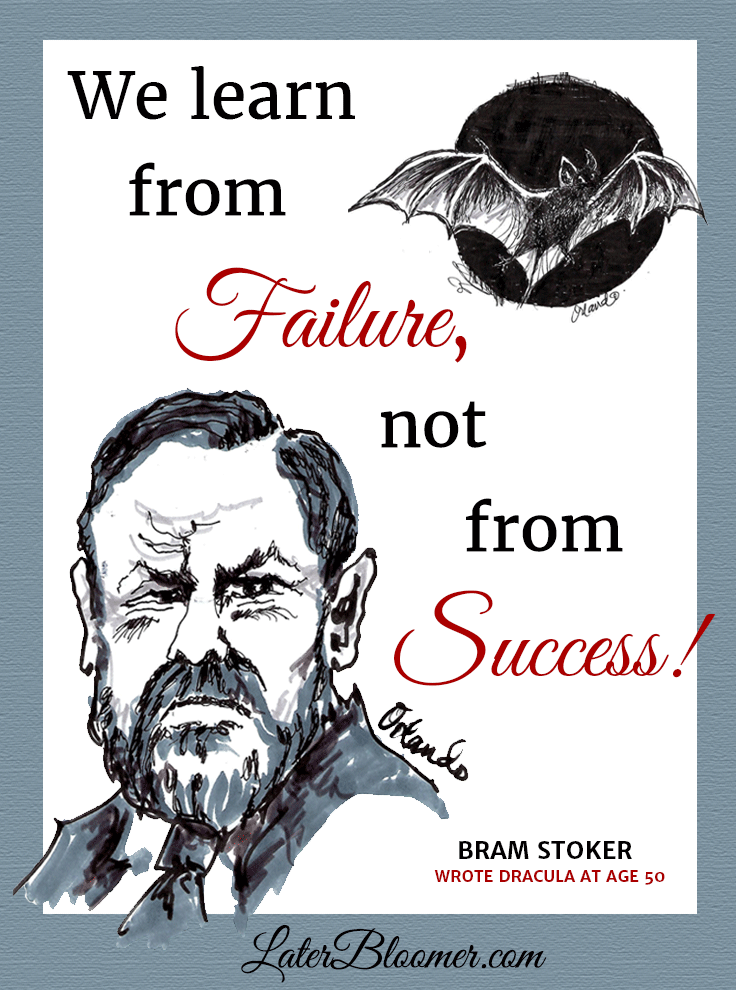
About the Artist above
Marianne Orlando is a freelance illustrator from Massachusetts, who’s known for her freehand drawings of people and houses. She has a style that is loose, relaxed, and unique (in an age of digital dominance and perfect pixels!). She does commissions for clients in Greater Boston, has illustrated four books (including one for WGBH/PBS), is pleased that one of her illustrations was published in a British journal, and has exhibited her work locally in public libraries.
A sufferer of clinical depression for a good part of her life, for the first time in many years—with the right care and medication—she now has a renewed zest for life. At the age of 62 she founded her own freelance business, drawings4hire, and is a true Later Bloomer. You can see samples of her work on Facebook here.
Story Sources
- The Irving Society
- Belford, Barbara. Bram Stoker and the Man Who Was Dracula.